Monday, February 17, 2014

Want to learn Sports Law and Investigative Reporting? Come to Concord, New Hampshire

I'm excited to announce the first ever Sports Law and Investigative Reporting course.

Sports Illustrated executive editor and head of Sports Illustrated's investigative team, B.J. Schecter, & I will co-teach this course at the University of New Hampshire School of Law from June 2 to June 6. By the end of the course, we expect students will have:
• Gained an overview of how the law interacts with sports and the reporting of sports. Relevant areas of law include criminal law, labor and antitrust law, intellectual property law, contract law, libel and defamation law, communications law and personal injury law. 
• Learned the key differences between a collective bargaining agreement, league constitution and league bylaws. 
• Learned how to effectively obtain investigatory information, including the “best practices” for using the Freedom of Information Act and states’ public records laws. 
• Developed strategies for advocating for and against “gag orders” in high-profile trials. 
• Become able to spot legal issues in fact situations involving disputes between and among leagues, teams and players. 
• Developed crucial skills for interviewing attorneys and agents who represent athletes that are in trouble with the law; general counsel of teams, leagues and sports companies. 
• Gained insight on how to develop sources, including law enforcement sources. Learned important obligations about protecting sources and reducing exposure to government and law enforcement interested in the information you possess. 
• Learned how to locate and understand key legal documents, such as complaints, subpoenas, search and seizure warrants, pretrial discovery (exhibits, witness lists etc.), grand jury transcripts so-called “independent” investigations and accompanying reports, and contracts of players, endorsers, licensors and broadcast companies. 
• Learned how to competently write, fact-check and vet sensitive stories. 
• Learned the “best practices” for breaking and commenting on sports law news, including appropriate use of Twitter. 
Our course is open to law students and attorneys, as well as to journalism students and journalists, and others who are interested in learning how to investigate and report on a news story that involves law and sports.  Front office personnel, university athletic department staff, sports agents, crisis management professionals and team and corporate communications specialists may also find significant value in the course.  You do not need an affiliation with UNH Law or UNH to take the course.  UNH Law is located in Concord, NH (the state's capital) and is about 70 minutes from Boston. 

For more on taking Sports Law and Investigative Reporting and other courses offered as part of the UNH Law summer institute on intellectual property and media law, click here.  Sports Law and Investigative Reporting is a one-credit course and costs $1,370.  Other available courses will include Internet Law, Advertising Law, and Fair Use of Copyrighted and Trademarked Work. 

We hope to see you this June!

Sunday, February 16, 2014

Harvard Law School Sports and Entertainment Law Symposium Friday 21, 2014

I look forward to speaking at Harvard Law School this Friday at their annual sports and entertainment law symposium.  Here are details on what should be an excellent event:

Harvard Law Sports & Entertainment Symposium
Friday, February 21, 2014
Wasserstein Hall
Harvard Law School
1585 Massachusetts Avenue
Cambridge, MA 02138
COST: Free!

Weiler Awards (lunch will be provided) (12:00 to 12:15)

Keynote (12:20 to 1:20)  

David Otunga, Harvard Law School alumnus and WWE wrestler

Panel #1: The Intersection of Business & Law (1:30 to 2:30)

Jay Cohen - General Counsel of the Dallas Cowboys
Andy Kim - Chief Financial Officer of The Weinstein Company
Richard Buchanan - Executive Vice President & General Counsel of the NBA
Cooper Campbell Jackson - Senior Vice President of Business Affairs at Sony
Michael McCann - Sports Illustrated legal writer & UNH Law professor

Panel #2: Representing Clients in Trouble with the Law (2:50 to 3:50)

Michael Fee - represents former New England Patriots TE Aaron Hernandez
Tamar Arminak - represents actress Amanda Bynes
Jay Reisinger - formerly represented baseball player Alex Rodriguez
Rodney Thomas - represents EJ Manuel and other NFL clients
Gabe Feldman - Tulane Law professor, @SportsLawGuy

Panel #3: Social Media – Blessing or Curse? (4:00 to 5:00)

Anthony D'Imperio - Vice President of Business & Legal Affairs at IMG
Dean Bahat - Business Affairs, FunnyorDie.com
Holly Bright - Bento Box Entertainment
Jerry Neeff - Entertainment Law professor at BU Law

Networking Reception (open bar and hors d’oeuvres provided) (5:00 to 6:30)

To RSVP, click here.

Saturday, February 15, 2014

Sports Law History: The Federal Baseball Decision of 1922

This is the sixth and final installment in a series of posts discussing my research into the history of the 1922 U.S. Supreme Court case of Federal Baseball Club of Baltimore v. National League, culminating in my recently released book, Baseball on Trial: The Origin of Baseball's Antitrust ExemptionClick here to read the earlier posts in the series.

Because both the Court of Appeals for the District of Columbia and the U.S. Supreme Court issued published decisions in the Federal Baseball case, most sports law enthusiasts are well aware of how Baltimore's suit against the major leagues ultimately fared on appeal.  Nevertheless, I was able to discover several interesting details about both proceedings during the course of my research.

For example, the court of appeals held its oral argument in Baltimore's case less than three weeks after the news that the 1919 World Series had been fixed became public.  The impact that the Black Sox scandal would have on the appellate court's decision in the case was undoubtedly a concern for the major leagues.  Indeed, some suspected that the court of appeals would conclude that baseball was subject to the Sherman Act because the scandal revealed the need for greater regulation of the sport.  On the other hand, it is also possible that the court may have been willing to allow the American and National Leagues greater leeway to collectively centralize their operations in order to impose the type of discipline and authority that the scandal necessitated.  Thus, it is ultimately unclear what impact, if any, the Black Sox scandal had on the appellate court's decision in the case.

The court of appeals eventually reversed the trial court and held that professional baseball did not constitute interstate commerce.  In particular, the circuit court characterized the major leagues as being engaged in "sport" not "commerce," while stating that Baltimore's case primarily focused on the reserve clause. This latter portion of the opinion has caused some subsequent courts and commentators to believe that the suit only involved allegations concerning the reserve clause, when in reality Baltimore's claims were broader.

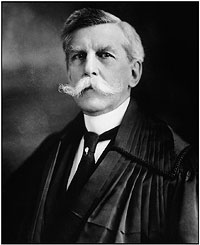
Nevertheless, the Supreme Court ultimately affirmed the court of appeals' decision in 1922.  Although the Supreme Court's decision has always been understood to be unanimous, my research revealed that at least two justices -- Brandeis and McKenna -- initially cast dissenting votes. Indeed, both justices eventually wrote to Justice Oliver Wendell Holmes, Jr. (pictured), the author of the majority opinion, to report that they were switching their votes so that the decision could be unanimous.

Justice Holmes's opinion in the case has regularly been misinterpreted, with many believing that it simply held that professional baseball was not sufficiently interstate in nature to fall within the Sherman Act.  In reality, Holmes' decision was premised on two separate grounds. Most fundamentally, he determined that baseball was not commerce, adopting the major leagues' characterization of the term as being limited to the production or sale of tangible goods. In particular, Holmes stated that "the exhibition, although made for money would not be called trade or commerce in the commonly accepted use of those words." In addition, Holmes also determined that professional baseball was not interstate in nature because the entire source of the industry's revenue -- i.e., ticket sales to baseball exhibitions -- was generated within a single state. The transportation of players across state lines, he concluded, was thus merely "incidental."

While subsequent commentators have been highly critical of Holmes' decision in the case, my research revealed that both parts of his holding were consistent with the legal precedents in place at the time.  Moreover, neither of these arguments was ever effectively rebutted by Baltimore's counsel in its briefing.  Therefore, my book ultimately concludes that the Federal Baseball case, although heavily criticized today, was in fact correctly decided given the applicable legal precedents in place in 1922.

Friday, February 14, 2014

Great Lakes Sports and Entertainment Law Academy

We've previously blogged about the Great Lakes Sports and Entertainment Law Academy, a summer program run by Peter Carfagna and Craig Nard and affiliated with Case Western and Cleveland-Marshall Law Schools for law students interested in sports and entertainment law. The academy, which offers distance learning, has a great deal to offer and will have courses this year from May 18 to June 7. For more information, click here.

Sports Law History: The Federal Baseball Trial of 1919

This is the fifth in a series of posts discussing my research into the history of the 1922 U.S. Supreme Court case of Federal Baseball Club of Baltimore v. National League, culminating in my recently released book, Baseball on Trial: The Origin of Baseball's Antitrust ExemptionClick here to read the earlier posts in the series.

Following the dismissal of the Baltimore Terrapins' initial lawsuit in Philadelphia, the club engaged in some limited settlement negotiations with the two major leagues over the next several months.  When those efforts ultimately failed, the team then opted to file a second lawsuit against the American and National Leagues in September 1917, this time in Washington, D.C.  It is not entirely clear why the team elected to file suit in Washington.  Baltimore likely hoped to avoid any potential prejudice from refiling the case in Philadelphia, and therefore simply opted for the closest city hosting a major league team (for service of process reasons).

Because the trial court never issued a formal written opinion in the case, relatively little has been known about the lower court proceedings in the Federal Baseball suit.  Baltimore's complaint was divided into two primary sets of allegations, the first dealing with the major leagues' monopolization of the professional baseball industry from 1903-1915, and the second contesting the ultimate destruction of the Federal League in 1915, both of which the team believed constituted violations of both federal antitrust and state law.  In particular, Baltimore alleged that the American and National Leagues had monopolized the industry in various ways, not only by securing their claim to nearly all professional players through the use of the reserve clause (thereby tying each player to his current team for the entire length of his career), but also by guaranteeing all major league teams exclusive control over their geographic territories.  This latter aspect of the team's case has often gone largely overlooked in modern treatments of the dispute, as courts and scholars have at times believed the case simply involved monopolization allegations relating to the reserve clause.

Due to the Washington court's congested docket, the suit would not be called for trial until March 1919.  The parties eventually staged a fourteen day jury trial, featuring testimony from a variety of baseball executives (including legendary Philadelphia A's manager Connie Mack) and former players.  Baltimore's newly retained legal counsel was able to present a much stronger case on the team's behalf than was asserted in the Philadelphia suit, emphasizing not only the dissolution of the Federal League in 1915, but also the major leagues' consistent monopolization of the industry for years prior.

Following the completion of the witness testimony, presiding judge Wendell Stafford allowed each side to present dueling motions for directed verdict, with both parties asserting that the undisputed evidence from the trial warranted a verdict in their favor.  These arguments ultimately turned on the question of jurisdiction, as the parties disputed whether professional baseball constituted interstate commerce, and thus was subject to federal antitrust law.  Baltimore's counsel stressed the fact that major league teams were spread across a number of different states, necessitating the transportation of both players and equipment across state lines, as proof that the leagues were engaged in interstate commerce.  The team's counsel was so convinced of the strength of their argument that they opted to voluntarily waive Baltimore's claims arising under state law, resting its case entirely on the applicability of federal antitrust law.  This decision would prove to be a critical mistake in hindsight.

Conversely, the American and National Leagues' counsel, George Wharton Pepper, argued that the business of professional baseball did not constitute commerce under the prevailing judicial definition in place at the time. In particular, Pepper stressed a series of precedents holding that commerce only involved the production or sale of tangible goods.  Because the major leagues produced no tangible products themselves, but instead merely sold tickets to ephemeral exhibitions of baseball (games that were staged entirely in one state, no less), he did not believe that professional baseball was engaged in interstate commerce.  Consequently, Pepper asserted, baseball could not be regulated under Congress's interstate commerce powers and therefore not subject to federal antitrust law. 

Judge Stafford adopted the plaintiff's view of the law.  He ruled from the bench that the major leagues were engaged in interstate commerce, and that they had illegally monopolized the industry in violation of the Sherman Act.  Stafford indicated that he was not entirely convinced that this determination was correct, however, suggesting that he was ruling in Baltimore's favor in part to avoid the potential need for a retrial, thereby allowing the already empaneled jury to resolve the remaining factual issues (namely, whether Baltimore had itself been harmed by the major league's monopoly, and, if so, what the extent of its damages were).  Had Stafford instead ruled in the major leagues' favor and dismissed the suit, only to have his decision overturned on appeal, the parties would then have had to stage a new trial to determine the remaining factual issues in dispute.

The jury ultimately returned a verdict awarding Baltimore $80,000 in damages (subsequently trebled to $240,000), much less than the $300,000 in damages the team had sought, but a significant victory nonetheless.  The major leagues, of course, immediately vowed to appeal the decision, and were confident that their position would ultimately be adopted by a higher court.  Their prediction eventually proved correct.

Thursday, February 13, 2014

Fan speech, again

I suppose I should wade back into the renewed interest in fan speech at sporting events, given two recent events at college basketball games: 1) Last week, Marcus Smart, a star player for Oklahoma State, was suspended for three games for shoving an adult fan at a game against Texas Tech,  in response to something that the fan, a prominent heckler at games, yelled at him (the fan, Jeff Orr, apologized for his role and voluntarily agreed not to attend any more games this season); 2) Last night, an adult fan was ejected from a game at the University of Memphis, apparently at the request of the referee.

I do not know all the details, so I am not necessarily opining on either situation. But both have people thinking about fan speech, so I would weigh in with what I think are the general principles at work (And I know very well that I am not on the side of the angels in this).


1) At a game involving a public university (as both Texas Tech and Memphis are), the First Amendment is in play. Any efforts to punish fans for their speech is subject to First Amendment limits. This applies, I would argue, even in a privately owned arena that a government entity (such as a public university) is using for its official governmental functions.

2) The stands of a publcily owned/controlled basketball arena are a designated public forum for "cheering speech," which is a broad category consisting of just about everything will say (and shout) during a sporting event that is not inconsistent with that event. This includes taunts, insults, profanity, and even some racist and sexist comments against players, coaches, and refs, as well as all manner of social and political speech.

3) As a public forum, content-based regulations (as on a particular type of cheering) are subject to strict scrutiny, while content-neutral regulations (no signs) are subject to intermediate scrutiny. There also could be reasonable viewpoint-neutral restrictions on non-cheering speech, but the category of cheering speech is so broad, I don't know what that would reach.

4) Fans can be punished for the rare speech that crosses the line into fighting words, which has been narrowed to reach only up-close, targeted, face-to-face taunts. It is possible that Jeff Orr crossed that line, since the incident occurred in very close range--Smart had fallen out of bounds right below where Orr was sitting. And Smart says he heard Orr use a racial epithet, although Orr says he just called Smart a "piece of crap." I do not know if this was a close enough encounter to fall outside the First Amendment, regardless of what was said.

5) Labeling what Orr did "fighting words" does not justify what Smart did. Contrary to what some apparently have said on ESPN, one person using fighting words does not mean the listener has license to fight. It simply means that the speaker can be sanctioned.

6) I legitimately cannot imagine what the fan at the Memphis game said last night that would have gotten him ejected and still be consistent with the First Amendment. Everyone at a basketball game is yelling and screaming and that is accepted as part of the game. So the ejection must have been based on the content of his particular screaming--a content-based enforcement that the First Amendment does not permit.

Sports Law History: The Baltimore Federals' Largely Forgotten Philadelphia Lawsuit

This is the fourth in a series of posts discussing my research into the history of the 1922 U.S. Supreme Court case of Federal Baseball Club of Baltimore v. National League, culminating in my recently released book, Baseball on Trial: The Origin of Baseball's Antitrust ExemptionClick here to read the earlier posts in the series.

Students of baseball history, and sports law enthusiasts, are likely aware that the Federal League's Baltimore Terrapins opted out of the Federal League-Major League peace agreement of December 1915, with the team instead electing to file its own antitrust lawsuit against the American and National Leagues.  That litigation, of course, ultimately culminated in the Supreme Court's 1922 decision giving rise to baseball's infamous antitrust exemption.  What fewer people realize, however, is that the suit that eventually made its way to the Supreme Court -- following trial court proceedings in Washington, D.C. -- was not the Baltimore club's first lawsuit against the major leagues.

Indeed, a few months after the Federal League-Major League peace agreement, the Baltimore Terrapins filed suit against the American and National Leagues in the federal district court for the Eastern District of Pennsylvania in Philadelphia.  The suit charged the major leagues with violating both Sections 1 and 2 of the Sherman Act, not only by conspiring to drive the Federal League out of business throughout its short life-span, but also by reestablishing monopoly conditions in professional baseball through the 1915 peace agreement.

Unfortunately for Baltimore, this initial lawsuit appeared to be ill-fated from the start.  Shortly before trial was scheduled to begin in June 1917, the team's lead attorney, and noted antitrust lawyer, William Glasgow became unable to try the suit as planned for unknown reasons.  Consequently, the club's general counsel, Stuart Janney, was forced to step in at the last minute to try the case himself on behalf of the team.  Janney struggled to effectively present such a complex case on short notice, and after three-and-a-half days of largely unproductive testimony, he abruptly and unexpectedly announced that the plaintiff was resting its case.

The bad news continued to mount for Baltimore early in the presentation of the defense's case, when the major league's first witness, National League President John Tener, testified that he was in possession of a transcript of the December 1915 peace negotiations between the Federal League and the major leagues.  Baltimore's counsel had been completely unaware of the existence of such a transcript, and upon reviewing the document that night determined that it largely undermined the team's case.  In particular, the transcript showed that Baltimore had been represented during the negotiations by two of its corporate executives, including its general counsel Janney, who had failed to object when Federal League officials made several unfavorable representations during the peace negotiations.  Because Janney had predominately focused his presentation of evidence on the illegality of the 1915 peace agreement, he believed the transcript largely undermined Baltimore's case, not only by suggesting that the team had acquiesced to the Federal League's dissolution, but also insofar as it placed him as an important witness to key events in the trial.

As a result, Janney stunned the crowd gathered in the courtroom at the beginning of the fifth day of the trial by announcing that the plaintiff was voluntarily dismissing its case.  Although some press reports speculated that a settlement must in the works, both sides insisted that that was not the case.  Indeed, despite withdrawing their suit, Baltimore's counsel sent a letter to the major leagues' attorneys that afternoon maintaining that the team continued to believe its rights had been violated.  Consequently, Baltimore would eventually file a second, broader antitrust suit against the major leagues several months later, this time in Washington, D.C.